Henry H. Goddard is not a household name, but his influence still lingers in America like the smell of cigarette smoke – clinging to the air, settling into fabric, and difficult to wash away. Goddard, who is one of the most infamous psychologists and eugenicists[1] in U.S. history, coined the term “moron” and played a key role in advocating for intelligence testing in schools and immigration policy, arguing that IQ scores could determine whether someone was fit to participate in society.
He is probably most known for his “study” (and I use that in the loosest sense of the term, even for the time period), which he published into a book in 1912, The Kallikak Family: A Study in the Heredity of Feeble-Mindedness. It was meant to be a case study of a family that proved that “feeble-mindedness” (a catch-all term that might include such things as mental illnesses, intellectual dis/abilities,[2] and learning dis/abilities) were genetically inherited.
In his infamous studies at Ellis Island, he administered English-language “intelligence” tests to non-English speaking immigrants, including such questions such as “What is Crisco?” (a U.S. cooking product) and “Who is Christy Mathewson?” (a baseball player), as if knowing these signified intelligence. This led to entire groups of immigrants being labeled as “feeble-minded,” leading to a surge in deportations.
The results of these studies were then used to justify exclusionary policies, including the Immigration Act of 1924, which dramatically restricted immigration from non-Anglo-European countries.
The results of these studies were then used to justify exclusionary policies, including the Immigration Act of 1924, which dramatically restricted immigration from non-Anglo-European countries.
But Goddard’s reach extended beyond immigration. His research laid the foundation for the widespread use of intelligence testing in special education, the military, and even the criminal justice system. Goddard argued that low intelligence, determined by [these biased and culturally irrelevant] IQ tests, could predict a person’s predisposition toward criminality, immorality, and “social unfitness.”
Even more, based on his Kallikak study, he promoted the idea that intelligence was hereditary and that those deemed “defective” should be institutionalized or sterilized to prevent them from passing on their “undesirable” traits. His work was deeply influential in shaping policies that led to the forced sterilization of thousands of dis/abled and historically marginalized people in the U.S.
Even more, based on his Kallikak study, he promoted the idea that intelligence was hereditary and that those deemed “defective” should be institutionalized or sterilized to prevent them from passing on their “undesirable” traits. His work was deeply influential in shaping policies that led to the forced sterilization of thousands of dis/abled and historically marginalized people in the U.S.
I have long been aware of eugenics’ role in shaping special education and statistics. As a researcher studying the role of assessments and the disproportionate identification of Black or African American and American Indian/Indigenous children in special education, I’ve spent years reckoning with the harm inflicted by these so-called scientific methods. But recently, I made a discovery that made this history feel disturbingly personal: Henry H. Goddard is my academic ancestor.
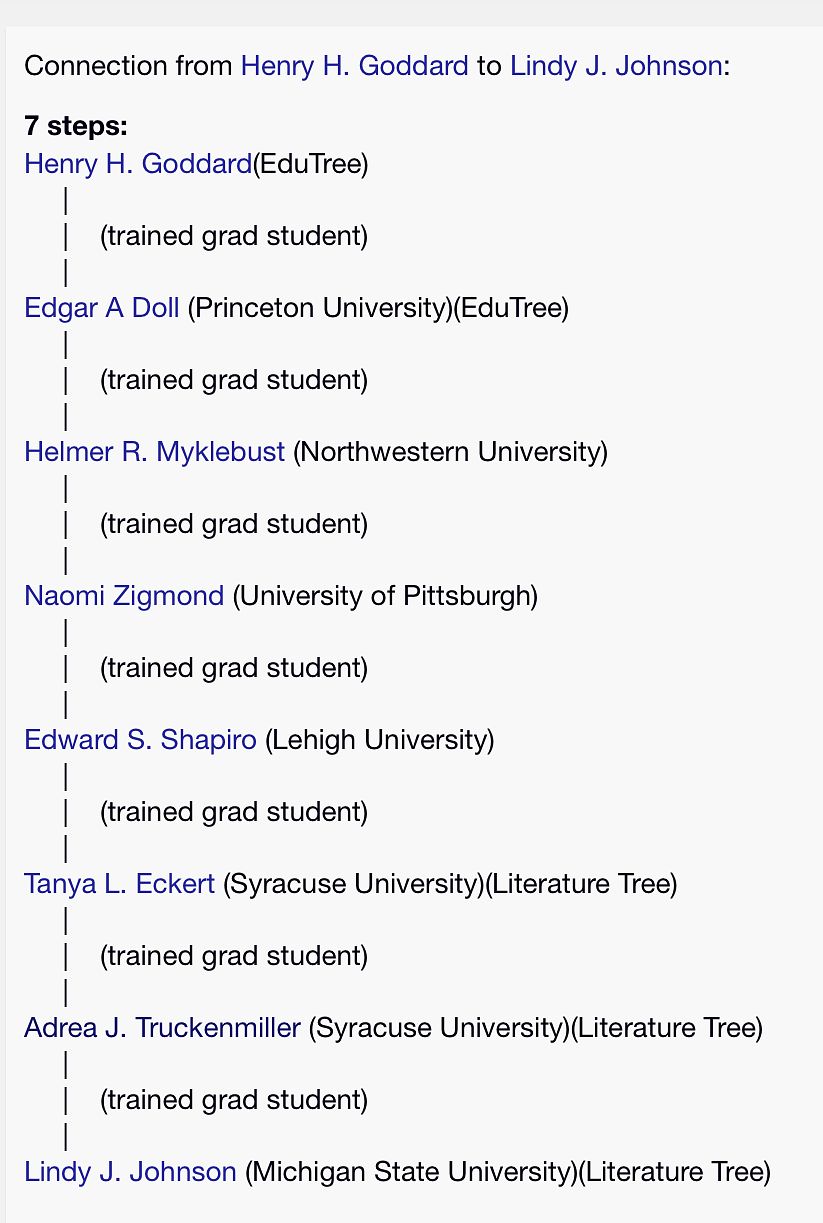
It started with a simple curiosity about my academic lineage — a term used to describe the mentorship tree of scholars, similar to a family tree, but tracing dissertation advisors instead of blood relatives. I knew academic genealogies existed, but I had never thought to check my own. When I finally looked, I expected to see familiar names from my field, scholars I had read and cited. Instead, I found an unbroken chain leading directly to Henry H. Goddard.
The realization hit me like a punch to the gut.
I had unknowingly inherited an academic lineage that traces directly back to a man whose work justified segregation, deportation, institutionalization, and forced sterilization – all in the name of “science.” Goddard’s work didn’t just influence American policies, either— it helped lay the foundation for Nazi eugenics.
His Kallikak Family study became a model for hereditary “defectiveness” that was cited by German eugenicists in the 1930s. (It is important to note that among many problematic methods/claims in the Kallikak book, it was ultimately found that the entire family tree was completely made up, thereby negating any and all arguments that Goddard was trying to make.) In 1935, the Nazi propaganda film Das Erbe used the Kallikak family tree to promote the idea that genetic ‘purity’ was necessary for the strength of the nation — an ideology that would directly lead to the forced sterilization of 400,000 people and, ultimately, the horrors of the Holocaust.
I felt a deep sense of unease, as though my work, my research, and even my place in academia were now tied to the legacy of a historical figure whose actions caused harm on a massive scale.
His Kallikak Family study became a model for hereditary “defectiveness” that was cited by German eugenicists in the 1930s. (It is important to note that among many problematic methods/claims in the Kallikak book, it was ultimately found that the entire family tree was completely made up, thereby negating any and all arguments that Goddard was trying to make.) In 1935, the Nazi propaganda film Das Erbe used the Kallikak family tree to promote the idea that genetic ‘purity’ was necessary for the strength of the nation — an ideology that would directly lead to the forced sterilization of 400,000 people and, ultimately, the horrors of the Holocaust.
I felt a deep sense of unease, as though my work, my research, and even my place in academia were now tied to the legacy of a historical figure whose actions caused harm on a massive scale.
At first, I didn’t know what to do with this information. Was it just an odd historical footnote, or did it mean something more?
The more I sat with it, the clearer it became – I couldn’t ignore it. Just as white Americans who discover their ancestors owned slaves must grapple with that history, I have a responsibility to confront and dismantle the harm that Goddard’s work created.
The more I sat with it, the clearer it became – I couldn’t ignore it. Just as white Americans who discover their ancestors owned slaves must grapple with that history, I have a responsibility to confront and dismantle the harm that Goddard’s work created.
Understanding my connection to Goddard has forced me to take an even closer look at how his legacy persists—not just in education but in modern policies that continue to wield data as a tool of exclusion.
This legacy—the weaponization of data to exclude, oppress, and marginalize—has not disappeared. It has simply evolved. Today, under the Trump administration’s 2025 policies, we see a resurgence of this same logic in new forms. The assault on diversity, equity, and inclusion (DEI), the rollback of disability accommodations like remote work, and the embrace of race pseudoscience by figures like Elon Musk and Peter Thiel are not new phenomena. They are part of the same eugenicist throughline that stretches from Goddard to now, with data once again being wielded as a weapon to justify exclusion and hierarchy.
The Trump administration’s return in 2025 has brought with it a wave of anti-immigrant, anti-diversity, and anti-disability rhetoric that echoes Goddard’s work in unsettling ways. Figures like Elon Musk and Peter Thiel openly promote race pseudoscience, using their platforms to claim that intelligence is biologically determined and that people of European descent are inherently superior. The administration’s dismantling of diversity, equity, and inclusion (DEI) programs, the attack on remote work (a critical disability accommodation), and the push to criminalize homelessness all reflect the same eugenicist logic: that some people are inherently more valuable than others.
The Trump administration’s return in 2025 has brought with it a wave of anti-immigrant, anti-diversity, and anti-disability rhetoric that echoes Goddard’s work in unsettling ways. Figures like Elon Musk and Peter Thiel openly promote race pseudoscience, using their platforms to claim that intelligence is biologically determined and that people of European descent are inherently superior. The administration’s dismantling of diversity, equity, and inclusion (DEI) programs, the attack on remote work (a critical disability accommodation), and the push to criminalize homelessness all reflect the same eugenicist logic: that some people are inherently more valuable than others.
Data is still being used to justify exclusion, just as Goddard used IQ scores to argue for the forced removal of immigrants and the institutionalization of disabled people. Modern surveillance tools—facial recognition, predictive policing, biased algorithms—continue to disproportionately target and harm marginalized communities, reinforcing existing hierarchies under the guise of objectivity.
This is why the myth of neutrality in social science is so dangerous.
The biggest flaw in Goddard’s work wasn’t just its racism and ableism (though those were enormous problems). It was his fundamental misunderstanding of what shapes a person’s trajectory.
Goddard ignored the role of environment. He failed to see how poverty, access to education, and structural barriers—not “bad genes”—shape life outcomes. Most people today can recognize the absurdity of his conclusions: of course, children raised in poverty, with limited access to education, will have different outcomes than those born into privilege. The Kallikak study didn’t prove inherited deficiency; it proved that systemic inequality exists.
But even more than that, Goddard ignored agency.
Because if genetics and environment alone determined our fates, I wouldn’t be where I am.
I am a first-generation college student. I come from a disadvantaged background. I have dis/abilities. Statistically, I was never “supposed” to be here. But I am. Because while genetics and environment play huge roles, they are not the only factors.
Mentorship matters. Resistance matters. The choices we make—the knowledge we build and the systems we challenge—matter.
If Goddard’s ideas were true, my connection to him would mean I should be continuing his work. Instead, I am proving, through my research, that his entire framework was a lie.
Goddard spent his career tracing biological lineage in an attempt to prove that “feeble-mindedness” was hereditary. His infamous Kallikak Family study falsely claimed that generational poverty, crime, and disability were the result of defective genetics rather than the impact of systemic inequality and environmental factors. His entire framework rested on the false premise that intelligence, morality, and worth were predetermined by bloodline.
So why, then, am I tracing my lineage—a lineage that isn’t even genetic?
Because unlike Goddard, I recognize what he refused to: environment, mentorship, and opportunity shape who we become. And even more than that—neither genetics nor environment alone determine destiny.
If they did, I wouldn’t be here.
I am a first-generation college student. I have faced systemic barriers, dis/abilities, and a disadvantaged background. Statistically, I was never “supposed” to make it this far. And yet, here I am—a fourth-year PhD student, actively dismantling the very systems that were designed to exclude people like me.
If Goddard’s theories held any truth, I would be continuing his work, not rejecting it. But the very fact that I am rejecting it proves that intelligence is not inherited—it is cultivated. My journey is a testament to the power of mentorship, resilience, and the choices we make.
As I traced my academic lineage, I noticed a turning point—one that mirrors the broader evolution in special education. The field began with a goal of identifying and segregating those who deviated from the norm. But over time, scholars began to question whether the goal should be exclusion or support.
For decades, the field remained dominated by men whose work centered on diagnosing and categorizing “deficiency,” as evidenced by the first few scholars who followed Goddard:
For decades, the field remained dominated by men whose work centered on diagnosing and categorizing “deficiency,” as evidenced by the first few scholars who followed Goddard:
- Edgar A. Doll continued the focus on intellectual disability, but moved toward understanding how to provide interventions.
- Helmer R. Myklebust worked on language disorders, pushing beyond pathology toward support.
But then, something shifted. Naomi Zigmond—the first woman in my academic lineage—entered the picture.
From that point forward, the focus changed. Zigmond, followed by Edward S. Shapiro, began centering services over exclusion, focusing on how special education could be structured to actually help students.
And then, something even more striking happened: a complete shift in mentorship.
Tanya L. Eckert mentored Adrea J. Truckenmiller (my direct advisor), who has continued moving away from the rigid deficit frameworks of the past and toward service, intervention, and equity. Instead of defining who was “unfit,” they are focused on how to provide access and opportunity.
My lineage moved from an unbroken chain of men defining “deficiency” to a new line of women mentors (or, as a friend calls them, “femtors” 🚺💖). Tanya and Adrea are part of the next wave of female special education researchers who focus on meeting students where they are rather than labeling them as deficient.
It’s a shift from gatekeeping to access. From sorting to serving. From pathology to possibility.
This legacy has been reclaimed and reshaped by women pushing for access and equity.
And now, I've entered the lineage.
From that point forward, the focus changed. Zigmond, followed by Edward S. Shapiro, began centering services over exclusion, focusing on how special education could be structured to actually help students.
And then, something even more striking happened: a complete shift in mentorship.
Tanya L. Eckert mentored Adrea J. Truckenmiller (my direct advisor), who has continued moving away from the rigid deficit frameworks of the past and toward service, intervention, and equity. Instead of defining who was “unfit,” they are focused on how to provide access and opportunity.
My lineage moved from an unbroken chain of men defining “deficiency” to a new line of women mentors (or, as a friend calls them, “femtors” 🚺💖). Tanya and Adrea are part of the next wave of female special education researchers who focus on meeting students where they are rather than labeling them as deficient.
It’s a shift from gatekeeping to access. From sorting to serving. From pathology to possibility.
This legacy has been reclaimed and reshaped by women pushing for access and equity.
And now, I've entered the lineage.
The discovery of my connection to Goddard is not a burden—it’s a challenge. If I have inherited any part of his academic lineage, let it be this: I will use my platform to dismantle the systems he helped create.
I refuse to let the legacy of exclusion define my work.
Instead, I choose to build on the shift my academic ancestors began, moving ever further away from deficit thinking and toward justice. My research interrogates the ways standardized assessments still fail marginalized students—particularly those who speak nonmainstream dialects or come from communities historically excluded from educational opportunity.
I am choosing to reshape the narrative. I am choosing to write a different future.
And legacy? It’s not just about what we inherit—it’s about what we choose to build and what we refuse to pass on.
I refuse to let the systems of exclusion that shaped my academic ancestry shape my work.
Instead, I choose to plant new seeds—seeds of justice, of equity, of writing as resistance.
Because, as Hamilton reminds us, legacy is planting seeds in a garden you never get to see.
I refuse to let the legacy of exclusion define my work.
Instead, I choose to build on the shift my academic ancestors began, moving ever further away from deficit thinking and toward justice. My research interrogates the ways standardized assessments still fail marginalized students—particularly those who speak nonmainstream dialects or come from communities historically excluded from educational opportunity.
I am choosing to reshape the narrative. I am choosing to write a different future.
And legacy? It’s not just about what we inherit—it’s about what we choose to build and what we refuse to pass on.
I refuse to let the systems of exclusion that shaped my academic ancestry shape my work.
Instead, I choose to plant new seeds—seeds of justice, of equity, of writing as resistance.
Because, as Hamilton reminds us, legacy is planting seeds in a garden you never get to see.
[1] Eugenics is a pseudoscientific movement that falsely claimed that intelligence, morality, and social worth were biologically inherited traits. It sought to control human reproduction to “improve” the population by promoting traits deemed desirable while eliminating those considered undesirable—an ideology deeply rooted in racism, ableism, and classism. Developed by Francis Galton in the late 19th century, eugenics was used to justify forced sterilization, segregation, and immigration restrictions, particularly targeting dis/abled people, racialized minorities, and the poor. Though widely discredited as unscientific, its influence persists in modern policies and attitudes about intelligence, genetics, and social worth.
[2] Why do I put a slash in the word dis/ability? Great question; glad you asked. 😉 I use “dis/ability” instead of “disability” because I believe the way we think about ability and disability isn’t just about a person’s body or mind—it’s also shaped by society. Scholars like Connor (2005), Hernández-Saca et al. (2018), and Annamma et al. (2013) have helped me understand that what we call “disability” isn’t just about an individual’s challenges. Instead, it’s deeply connected to history, politics, economics, and social attitudes. The slash (/) in “dis/ability” is a small but intentional way to highlight that both “ability” and “disability” exist in relation to each other, shaped by the world around us—not just by any one person’s body or brain.
[2] Why do I put a slash in the word dis/ability? Great question; glad you asked. 😉 I use “dis/ability” instead of “disability” because I believe the way we think about ability and disability isn’t just about a person’s body or mind—it’s also shaped by society. Scholars like Connor (2005), Hernández-Saca et al. (2018), and Annamma et al. (2013) have helped me understand that what we call “disability” isn’t just about an individual’s challenges. Instead, it’s deeply connected to history, politics, economics, and social attitudes. The slash (/) in “dis/ability” is a small but intentional way to highlight that both “ability” and “disability” exist in relation to each other, shaped by the world around us—not just by any one person’s body or brain.